
What Happens to Solar Panels During a Power Cut
A common assumption is that having solar panels means the lights stay on during an outage. For a standard grid connected system, that assumption is wrong, and the reason is a safety requirement, not a fault.
Why solar panels normally stop working during a power cut
During a power cut, a standard home solar PV system stops generating electricity for the home, even if the panels are sitting in full sunlight. This is not a fault or a design weakness, it is a deliberate safety feature built into every grid connected inverter, and it applies whether or not the system includes a battery.
Why the inverter shuts down
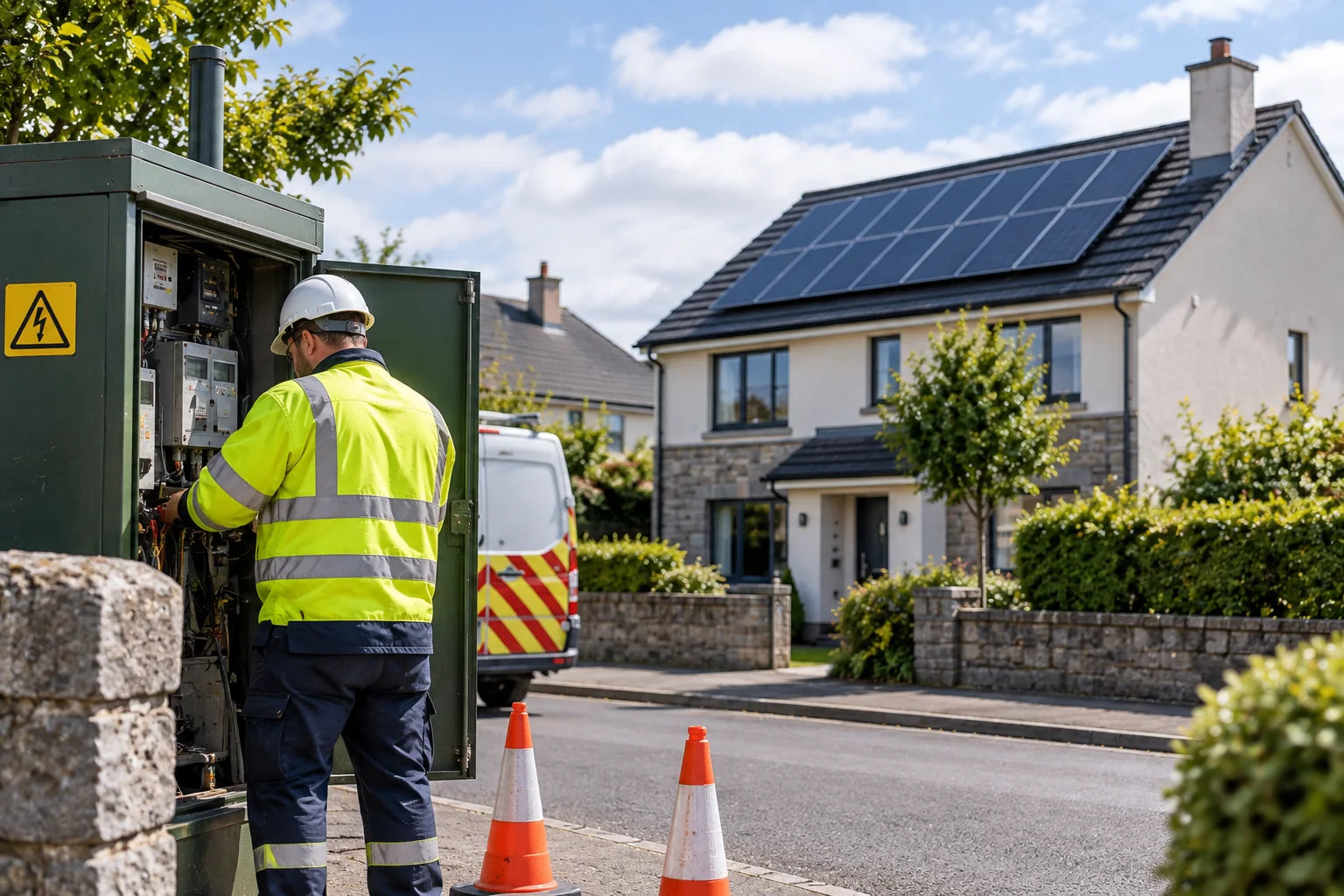
A home solar PV system is connected in parallel with the electricity network, and it normally works alongside it, drawing on the grid when the home needs more than the panels are generating and exporting surplus back into it when the panels are generating more than the home needs. During a network outage, engineers may be working on the lines to restore supply, and a solar inverter that kept sending electricity into those lines from your roof would create a genuine safety hazard for anyone working on what they expect to be a dead circuit.
To prevent this, every grid connected inverter includes a protection feature known as anti islanding, which detects when the wider grid has gone down and automatically disconnects the system, stopping it generating power for the home or exporting to the network until it detects the grid has been safely restored. This is a standard, required feature of any system connected under the arrangements set out by ESB Networks for home solar installations, not an optional extra some installers include and others skip.
Does having a battery change this
Not automatically. A battery stores surplus electricity for later use, but a standard battery installation is still wired to work within the same grid connected system, and it will shut down along with the rest of the system when the inverter detects an outage, regardless of how much charge the battery is holding at the time. Our guide to choosing a solar battery covers sizing and specification in more depth, but sizing alone does not determine whether a battery can power the home during an outage.
What backup power actually requires
Providing electricity to some or all of a home during a power cut is a genuinely separate capability from ordinary solar generation or storage, and it needs to be specified and installed deliberately rather than assumed. In general terms, this requires a hybrid inverter with a backup or emergency power function, that function enabled in the system's settings, a battery with charge available to draw on, and specific circuits in the home wired through to a dedicated backup connection point rather than through the ordinary household wiring. Without all of these in place together, a battery will not power anything in the home during an outage, no matter how much energy it is holding.
The exact wiring standards and certification requirements that apply to this kind of installation are a matter for a qualified electrical contractor working to the wiring rules that apply in Ireland, and they are outside the scope of this guide. If backup power during an outage matters to you, raise it directly and explicitly with your installer at the quotation stage, since it is not something to assume comes as standard with a battery purchase.
Questions worth asking if backup power matters to you
- Does the quoted inverter support a backup or emergency power function, or would a different inverter be needed
- Which circuits in the home would actually be covered during an outage, and which would not
- Is that backup function included in the quoted price, or is it a separate cost
- Does the battery need a minimum reserve charge set aside for backup use, and how does that affect how much capacity is available for ordinary daily storage
- Who is responsible for certifying the backup wiring once it is installed
For the broader picture of what a solar PV system involves, how it is sized, and current SEAI grant support, see our guide to Solar PV systems and grants.