
Solar Batteries in Ireland: How to Choose the Right Size
If you already have a solar quotation with a battery on it, the headline kWh figure is the least useful number on the page. Here is what actually determines whether a battery earns its place, and what to check before you commit to a size.
Start with how the battery will actually be used
Two batteries advertised at the same kWh capacity can behave quite differently in daily use, and a battery sized around the wrong assumption can sit half empty every evening or fill up and stop helping by lunchtime. This guide works through the specifications and usage patterns that actually decide whether a battery is doing useful work in your home, separate from the general question of whether solar PV suits your home at all, which our main guide to Solar PV already covers.
Usable capacity is not the number on the box
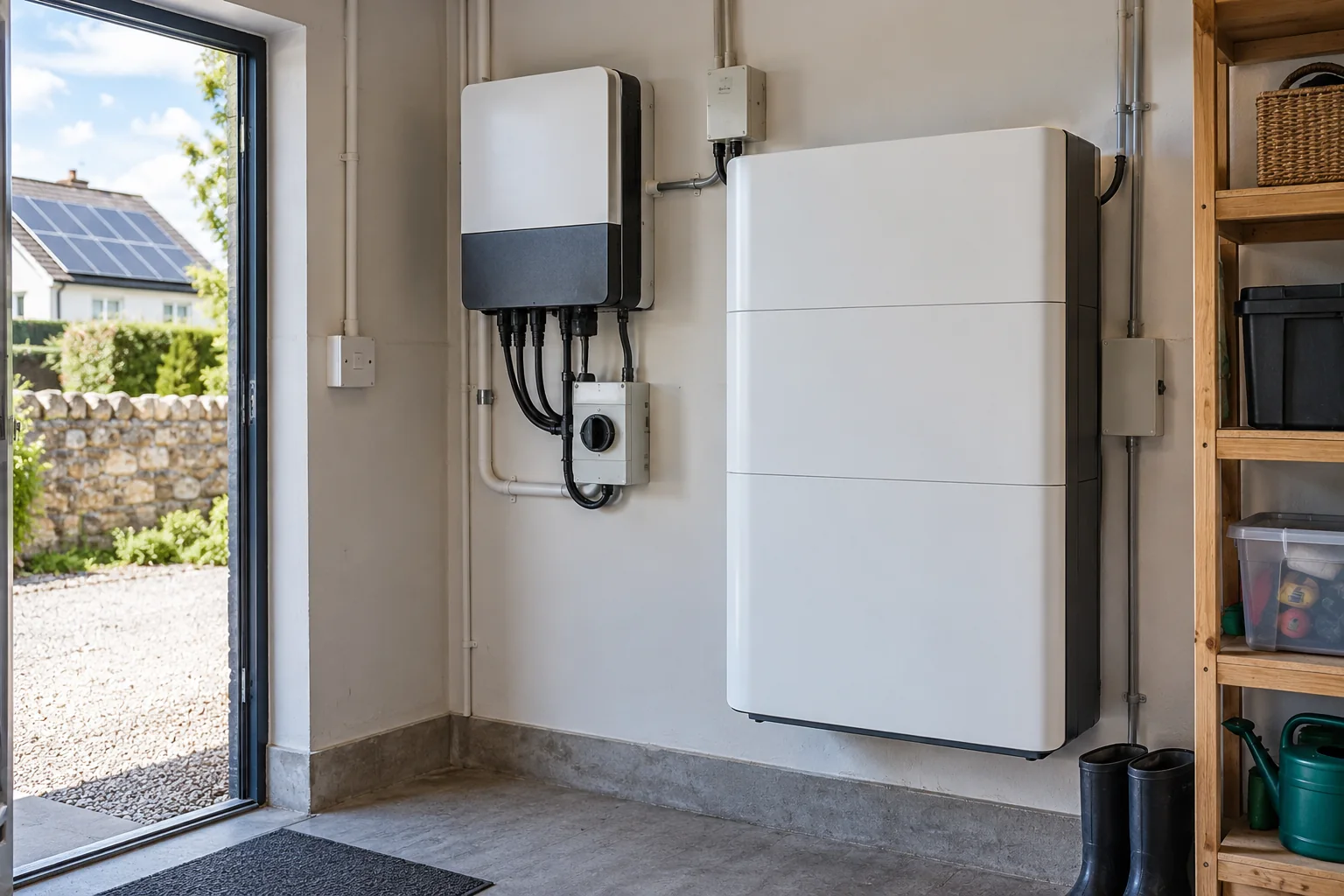
The headline kWh figure quoted for a battery, sometimes called its nameplate capacity, is the total energy it can theoretically hold. What you can actually draw back out is its usable capacity, which is almost always lower once depth of discharge limits are applied.
Depth of discharge describes how far a battery is allowed to be run down before it stops supplying power, a limit manufacturers set to protect the battery's lifespan. A battery with a stated capacity of 10kWh and an 80 percent depth of discharge limit delivers around 8kWh of usable energy in practice, not 10kWh. Manufacturers vary in how they publish this figure, and some now advertise a much higher usable percentage than others, which is exactly why two batteries with the same headline number can perform differently in your home. Always ask for the usable capacity in kWh, not just the nameplate figure, when comparing quotations.
Capacity and power are two different specifications
Capacity, measured in kWh, is how much energy a battery can store. Power, measured in kW, is how quickly it can deliver that energy at any one moment. A battery can hold plenty of stored energy and still be unable to cover a high simultaneous demand in the home, such as an immersion heater, an electric shower and a kettle running at the same time, if its power rating is too low for that peak. When comparing quotations, check both figures rather than assuming a larger kWh number automatically covers a higher demand household.
How your daytime electricity use changes the case for storage
A battery earns its keep by storing solar electricity your home is not using as it is generated, so it can be used later instead of being exported. This makes daytime occupancy the single biggest factor in whether a battery adds much value.
A household that is largely out during the day, with most of its electricity use concentrated in the evening, tends to export a large share of its solar generation without a battery. Storing that surplus for the evening peak is exactly the scenario a battery is built for. A household that is home during the day, already running appliances, charging equipment or working from home while the sun is up, is already using a larger share of its own generation directly, which leaves less spare surplus for a battery to capture. Neither pattern makes a battery pointless or guaranteed to pay off, but they change how much a battery actually has to do.
What happens when the battery is full, and when it is empty
Once a battery reaches its usable capacity, further solar surplus is not wasted outright, it is exported in the normal way under the Clean Export Guarantee arrangements our main Solar PV guide explains for exporting electricity. It simply is not stored for later, so a battery that fills every day before your peak evening use has, in effect, already done all the work it can do that day. Adding a bigger battery only helps if there is more daily surplus left to capture once the existing one is full.
When a battery runs down to its depth of discharge limit, the home draws electricity from the grid as normal, the same as it would without a battery at all. This is a separate question from whether a battery can keep the lights on during a power cut, which is covered in its own detail in our article on what happens to solar panels during a power cut. A standard battery does not provide backup power automatically, even when it is fully charged, unless the system has been specifically fitted and configured for that.
Charging from the grid, not only from solar
Many home batteries can be charged from the grid as well as from solar panels, and on a time of use electricity tariff this opens up a second use for a battery that has nothing to do with solar generation at all. Suppliers in Ireland increasingly offer tariffs with a much cheaper overnight rate and a more expensive rate during the evening peak. A battery can be set to charge from the grid during the cheap overnight window and discharge during the expensive peak hours, independent of how much the sun shone that day.
This means the value of a battery is not purely a solar question. A household on a time of use tariff with a strong night rate may find a battery useful even in winter months when solar generation is low, simply by shifting grid electricity from a cheap hour to an expensive one. Whether this is worthwhile depends entirely on the specific tariff on offer, which changes between suppliers and over time, so this is a question to check directly with your own electricity supplier rather than assume from a generic figure.
Does exporting reduce the case for storing every surplus unit
If a supplier is already paying you to export surplus electricity under the Clean Export Guarantee, storing that same unit only makes sense if using it yourself later is worth more than the export payment would have been. In practice this usually favours storage, since the price you avoid paying for electricity you would otherwise have bought is generally higher than the rate paid for exporting it, but this is a comparison worth checking against your own supplier's current export rate and unit price rather than assuming it always holds. A portion of microgeneration export income is also currently exempt from tax up to an annual threshold set by Revenue, which is a separate matter from the storage decision itself and worth confirming directly with Revenue if export income matters to your circumstances.
Why two batteries with the same headline size can perform differently
| Specification | What it tells you | Why it varies between products |
|---|---|---|
| Usable capacity | The energy you can actually draw, not the nameplate figure | Depth of discharge limits differ between manufacturers and chemistries |
| Power rating | How much load the battery can supply at once | A high capacity battery can still have a modest power rating |
| Round trip efficiency | How much of the energy put in comes back out again | Conversion and storage losses mean some energy is not recovered |
| Warranty term in years | How long the manufacturer stands behind the product | Calendar warranties are set independently of usage |
| Warranty cycles or throughput | How much use the battery is warrantied for, separate from age | A battery used daily can reach a cycle limit long before a time limit |
| Guaranteed capacity at end of warranty | How much capacity you are promised will remain | Some warranties guarantee a minimum percentage, such as around 70 percent, others do not state one clearly |
Reading a warranty properly
Battery warranties are typically expressed on two bases at once, a number of years and a number of charge cycles or a total amount of energy throughput, whichever limit is reached first. A battery cycled once a day, every day, can reach a cycle limit well before a ten year calendar warranty would otherwise expire, particularly if it is also being used for grid charging on a time of use tariff rather than solar storage alone. Ask for both figures, and ask what capacity the manufacturer guarantees will remain at the end of the warranty period, since a warranty that only promises the battery will still switch on is a much weaker guarantee than one that promises a stated minimum capacity.
Adding a battery now or later
A battery does not have to be decided at the same time as the panels. Adding one afterwards is usually described as an alternating current connected retrofit, where a separate battery unit is added on the household side of the existing solar inverter, or a direct current connected approach, which integrates more closely with a compatible inverter and can sometimes require replacing the original one. An alternating current connected retrofit is generally the more straightforward route if the existing solar inverter is working well and you simply want to add storage later, since it avoids disturbing the panels or their wiring.
Some battery products are also designed to be expanded later by adding further modules, up to a limit set by the manufacturer and the inverter. This is a genuinely useful feature if your electricity use is likely to grow, but it depends on the specific product and inverter combination rather than being universal, so ask directly whether the system you are quoted can be expanded and what the practical limit is.
Any battery added to a home solar system, whether at the same time as the panels or later, needs to be registered with ESB Networks as part of the microgeneration connection, in the same way the solar panels themselves are. Confirm with your installer that this has been included rather than treated as an afterthought.
What to compare between battery quotations
- Usable capacity in kWh, not only the nameplate figure
- Power rating in kW, and whether it covers your household's peak simultaneous demand
- Round trip efficiency, if stated
- Warranty term in years
- Warranty cycle or throughput limit
- Guaranteed minimum capacity remaining at the end of the warranty
- Whether the battery can charge from the grid as well as from solar, if a time of use tariff matters to you
- Whether backup power during an outage is included, or would need additional equipment
- Whether the battery can be expanded later, and by how much
- Confirmation the battery will be included in the ESB Networks microgeneration registration
For the broader questions of whether solar PV suits your home, how a system is sized, current SEAI grant support and general payback, see our guide to Solar PV suitability, costs and grants, including its own payback tool for working through your own figures.