
Replacing Windows and Adding Wall Insulation: How to Coordinate the Work
Both our main guides say the same thing in passing, speak to both contractors before either job starts. This article is the detail behind that sentence, so you know exactly what to ask each one to agree.
The order of the work can affect the finished result
Our main guide to Windows and Doors and our main guide to Home Insulation both note that window replacement and wall insulation should be coordinated when both are being planned. This article sets out what that coordination actually needs to cover, since a general instruction to speak to both contractors is only useful once you know what to ask them to agree.
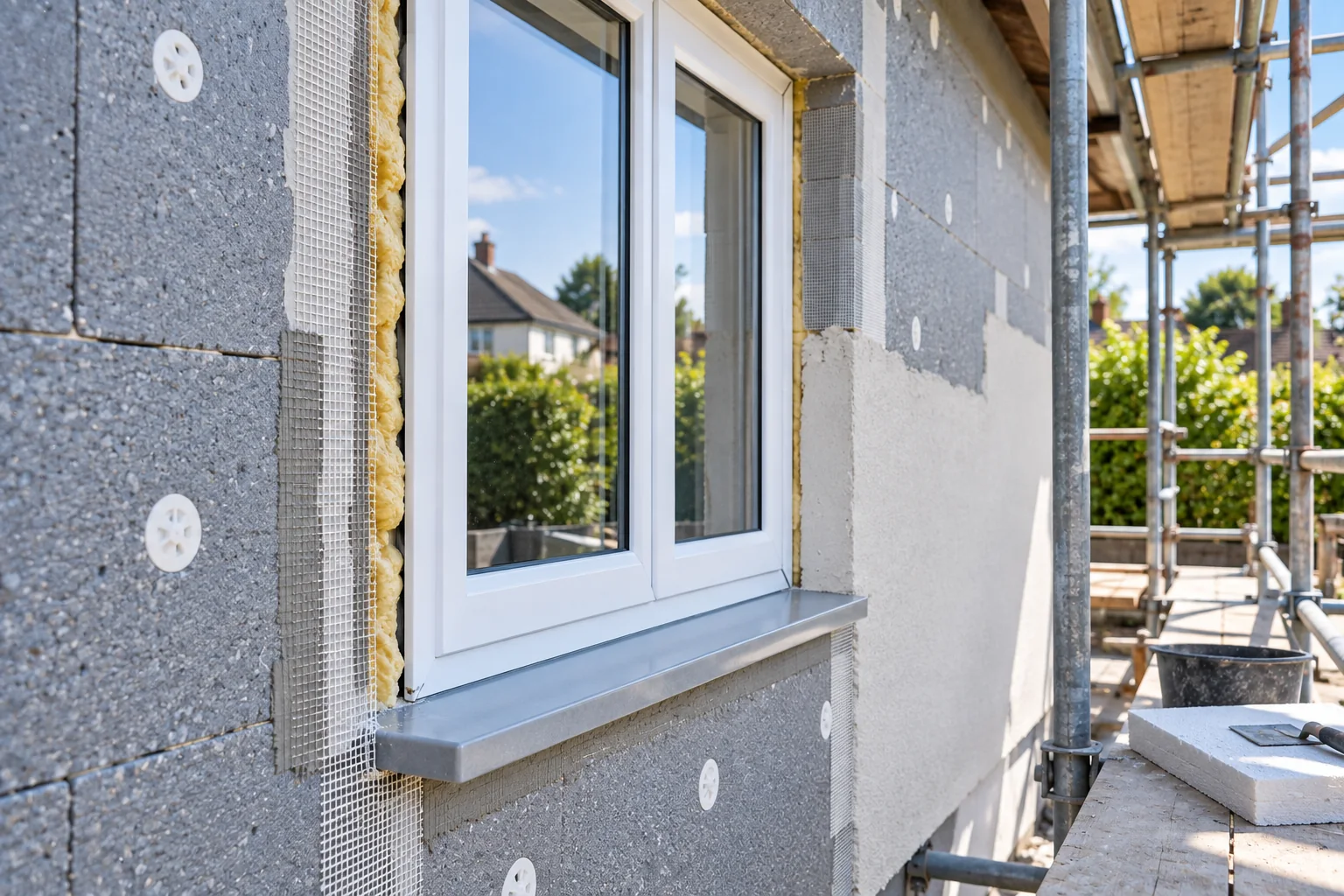
Why the two projects genuinely interact
External wall insulation adds a layer of thickness to the outside of the wall, which changes the depth of the reveal, the recessed section of wall around a window opening, and can affect how far a window needs to sit within that opening, how the sill extends beyond the new wall thickness, and how the edge of the insulation is finished and sealed against the window frame. Internal wall insulation similarly changes the internal reveal, affecting how a window frame meets the newly thickened internal wall face. If you have not yet settled which of the two methods you are using, our guide to choosing between internal and external wall insulation covers that decision. Whichever method applies, whichever job happens first sets constraints the other job then has to work around, which is why sequencing and communication between the two contractors matters more here than on two genuinely unrelated projects.
What should be agreed before either job starts
| Item | What to agree |
|---|---|
| Sequence | Which job happens first, and why, given the specific insulation type and window positions involved |
| Reveal depth | How the reveal will be finished once both jobs are complete, and whether the window needs to be repositioned within the opening to suit the new wall thickness |
| Sills | Whether existing sills will be extended, replaced or reset to suit the new wall thickness, and who is responsible for that work |
| Insulation continuity | How the insulation layer will meet the window frame without a gap or a thin, poorly insulated strip around the opening |
| Thermal bridging at the junction | How the specific junction detail between frame and wall will be treated by whichever contractor's work reaches that point last |
| Weather sealing | Who is responsible for the external weather seal at the junction once both jobs are finished, so it is not left as an assumption on either side |
| Snagging and responsibility | What happens if a problem appears at the junction after both jobs are complete, and which contractor is responsible for investigating it |
Getting it in writing
Neither contractor is likely to think through the other's work in detail unless you specifically raise it, since each is naturally focused on their own scope. Once you have discussed the items above with both contractors, ask each one to confirm their understanding of the agreed sequence and the junction detail in writing, as part of their quotation or a written exchange, rather than relying on a verbal conversation on site. This matters most for the weather sealing and responsibility questions, since a junction problem that appears months later is much easier to resolve if it is clear from the outset which contractor's scope it falls under.
Before either job starts
- Agree and record the sequence, and the reason for it
- Agree how reveals and sills will be finished once both jobs are complete
- Agree how insulation continuity will be maintained right up to the window frame
- Agree which contractor is responsible for the weather seal at the junction
- Get each contractor's understanding of the above in writing
For general window and door installation quality and current SEAI grants, see our guide to Windows and Doors installation and grants. For internal and external wall insulation methods and current SEAI grants, see our guide to Home Insulation methods and grants.